
Gathered Leaves
Park Theatre - Interview with writer Andrew Keatley.
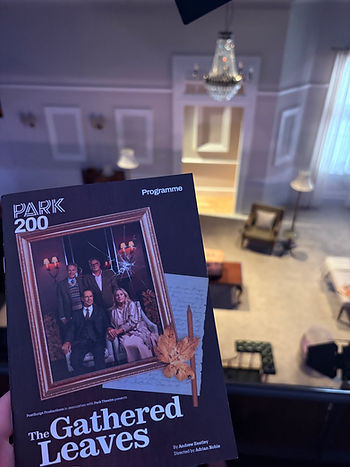
After seeing the marvellous 'Gathered Leaves' at the Park Theatre a few weeks ago, I was utterly blown away. I couldn't get the show out of my mind, and I had so many questions. Andrew Keatley wrote the show, and luckily, he answered a few of my burning questions.
If you haven't seen 'Gathered Leaves', be sure to catch it at the Park Theatre, where it plays until 20th September 2025. Do not miss it! It follows a family who have a lot of history that has been brushed under the rug, and the show is all about dealing with their history. Making mends. It deals with emotive themes and makes a statement about parenting, particularly with autism. Family isn't just blood, you get so much from your parents... What have the characters in this show taken from their parents? Want to know more about the show? Check out my review
Here is what the writer Andrew Keatley had to say:
Q: What inspired you to write the play? What does it mean to you?
A: I wanted to write a family drama, three generations, upper middle-class, in
which the problems of the past absolutely need to be addressed. It’s not an original
idea – in fact, it’s a very traditional idea – but I wanted to see what sort of house and
family I could build.
I had this notion of a patriarch who had no real relationship with
his autistic son, but that the onset of dementia, and the decline of his faculties, might somehow open up a channel for him and his son to bond. Even if that bond
was built on a false premise. I am fascinated by autism (or ASD as it is generally
now called), and I was interested to explore how a character like Samuel might sit in
In the midst of such a family.
I had watched some documentaries about Stephen Wiltshire and Derek Paravacini, and seeing those just deepened my interest.
In terms of what the play means to me, that’s a very hard one to answer. I love the
play dearly, and the characters too, all of them. They are all struggling to find the
best way forward, but I think they are all trying. It’s all very real to me, even though I
categorically know that none of it is real. It’s a strange paradox.
Q: How has the play developed since the previous run?
A: It’s been a case of reconstitution. The flesh and bones of the play are the
same, but it’s now set just in one room, and several scenes have now been threaded
together to happen in sequence rather than as individual stand-alone moments. That
sort of thing. Plus a couple of new scenes and extensions of old scenes. And lots
and lots of small cuts. But it’s still essentially the same play.
Q: Have you got a favourite moment from the show?
A: I don’t think I have. I’m not particularly good at watching things I’m involved in. I
find it hard to relax, and I’d rather be in another room imagining that it all going
absolutely perfectly. I suspect that many of the company probably have their
favourite moments and/or lines. Our ASM Joni’s favourite line, which is when Simon
is on his own, preparing to turn on the TV (which he knows he probably shouldn’t do)
is “It’s just the television. It’s not the gateway to hell.” So how about that?
Q: What's your favourite audience reaction?
A: I think the exchange between William and Giles at the end of the play is a really
big moment in the play – it’s a small moment dramatically, but the emotional weight
of it is huge, so I feel a connection with any audience members who are visibly
affected by that moment.
Q: Tell us about the set and its significance to the story?
A: The set is designed by Dick Bird, who these days tends to work mostly in ballet
and opera all over the world, so to get him to do something on this small scale was
something of a coup. Initially, we were going to do the play In The Round – but after a
couple of site visits to the space, we decided that a conventional Park200 thrust stage was a better option.
I think we wanted the set to offer a sense of the relative grandeur of the Pennington home, but not be overly fussy in terms of detail. The Pennington home is a hugely important component part within the play, particularly the drawing room. It’s the scene of so many memories – good, bad, and haunting. I think Dick’s done a fantastic job of creating a space that is instantly recognisable and enables an audience to orient themselves in the lives of the Pennington family immediately.
Q: What research went into writing?
A: When I have an idea for something to write, then I tend to just start writing, and
when I hit something that I think it might be a good idea to know more about, then
that’s when I stop and do some research. It could be just to answer a simple
question about what TV programmes were broadcast on a specific date, or it could
be a much bigger and knottier thing, like trying to get to grips with what the
landscape was like for a child with autism in the 1950s – and for the child’s parents –
before autism was a common diagnosis. In basic terms I like to write character-
based drama – ideally, the characters interest me for some big reason, and they live
in a world that feels suitably challenging, but that there is a chance for them to
achieve something – to change in some way – find something, learn something, do
something beyond their own expectation.
That’s what is important to me. Once I know enough about who those characters are, then I generally know what I need to research. Other writers no doubt decide that they are interested to write about a certain world or period of history and head straight into research mode, but that just doesn’t seem to work for me.
Q: Sum up the show in one sentence?
A: I think that’s really a job for critics and marketing teams, so you go right ahead!

Make sure you don't miss the show. It is such a well-written play and will get you thinking. Click here to book your tickets.


Comments